A restaurant website with online ordering, built for a friend before he asked for one.
An old roommate of mine runs a bakery and pizzeria. Two locations, twenty four years in business. His website was built in WordPress and his online ordering was spread across four separate platforms that do not talk to each other.
I had an idea about what it could be instead, so I built the whole thing first and showed it to him afterward. There is no slide deck. The site is the pitch.
A site built to sell
The home page is built around each revenue line, a section apiece for the bakery, the pizzeria, custom cakes and wholesale, with the last two big enough to get their own pages.
Underneath sit customer reviews, seasonal merchandising that turns over with whatever is coming out of the oven, and email capture for the people who are not buying today.
A complete online store
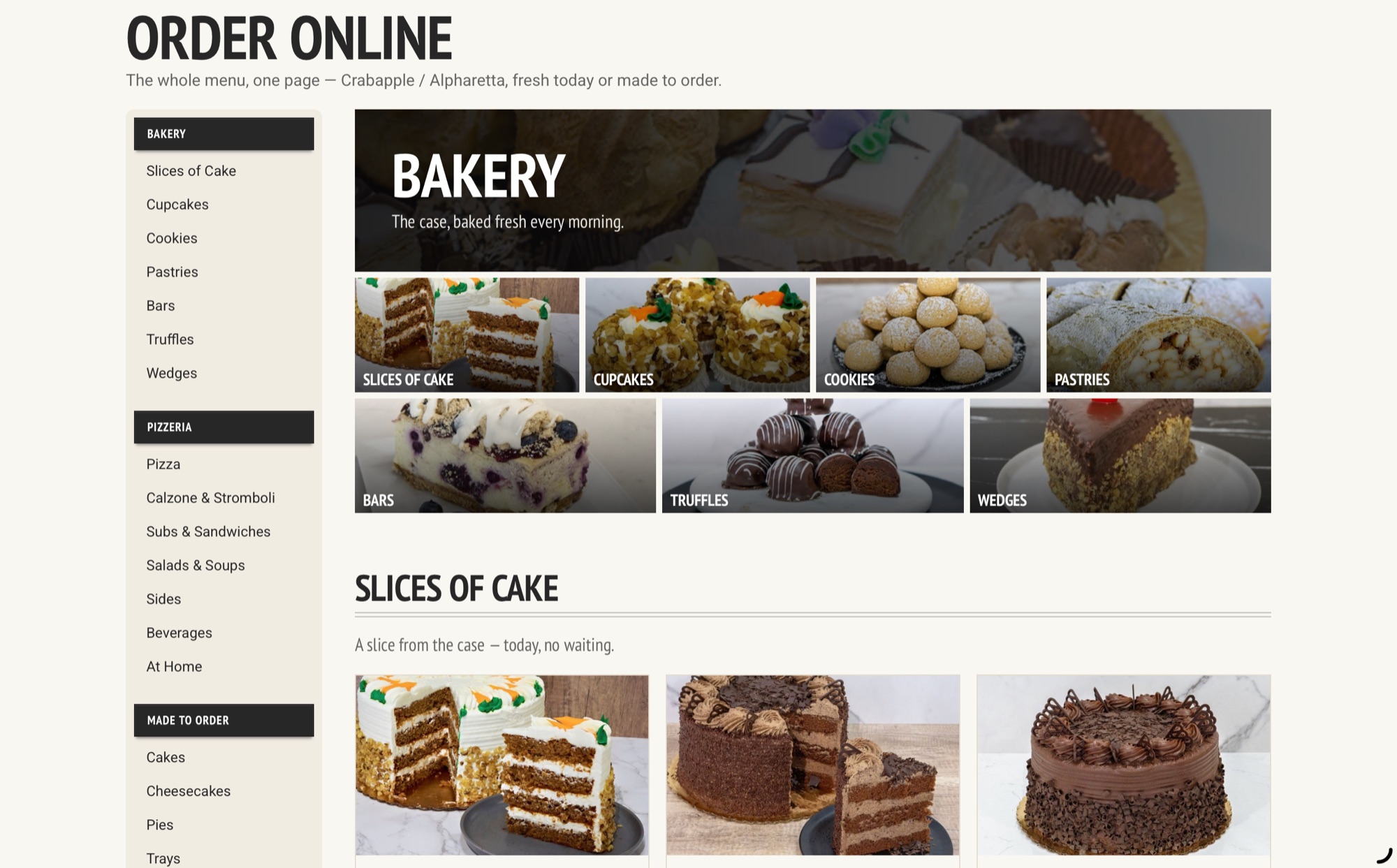
A customer browses, customizes, pays, gets a receipt, and tracks the delivery without ever leaving the site or picking up a phone.
It is built for a phone first, which is where nearly all restaurant ordering actually happens. The ordering page is designed for a thumb: categories collapse, one open at a time, so nobody scrolls past four hundred items to find a sandwich. Multiple locations are handled throughout, and switching shops does not lose your place.
Integrated with the point of sale
Orders from the website go into the same system the registers use, so the kitchen works one queue instead of watching a counter and a website separately.
The menu, the prices and the modifiers come from that same system. There is nothing to keep in sync by hand and no second place to update when something changes.
Delivery without hiring drivers
Delivery is dispatched through Uber, so there are no drivers to hire and no vans to insure. The real cost for that specific address comes back before the customer commits, and an address outside the delivery range is caught while they can still do something about it.
DoorDash delivery is built and tested too. It went first, and it sits dormant because DoorDash closed production access partway through the build.
Custom intake forms for what gets quoted instead of bought
Custom cakes and wholesale do not get a cart, because neither one is sold that way. Both get a custom intake form built for how that part of the business actually works.
The cake form asks how many people it has to feed, takes as many inspiration links as somebody wants to paste in, and collects the venue and the contact. Wholesale has its own partner inquiry.
The owner runs it himself
He edits his own menu: reorder it, hide what sold out, rewrite a description, swap a photo.
And every piece of copy on every page, down to button labels and form placeholders. Nothing on the site needs a developer to change it.
Point of Sale Integration
Orders are built as Square orders and paid through Square, so they land on the register like any other ticket. His processor, his rates, nothing new to reconcile. It runs end to end against Square's test environment, and pointing it at the owner's real account is the last step.
On-Demand Courier Dispatch
The delivery price comes live from Uber Direct for the customer's actual address before they commit, and an address outside the radius gets caught right there. Placing the order creates the delivery and hands back Uber's own tracking link. The demo runs in Uber's test mode, so no driver is sent.
Hosting
A Laravel app on my own Linux server, with plain JavaScript on the ordering page.
This is not his live website. It is a finished demo sitting at its own address, waiting on a conversation. Orders do not reach the register yet, the intake forms confirm without submitting anywhere, and the gift card page stops at a screen that says so out loud rather than pretending.
I built it to the point where it feels real on purpose. A slide deck was never going to explain any of this, and the entire argument is what it would be like to use.