A mystery told in twelve letters that arrive in your mailbox.
I wanted to make something that shows up in your mailbox. My mom reads mysteries and pretty much nothing else, so it became a mystery.
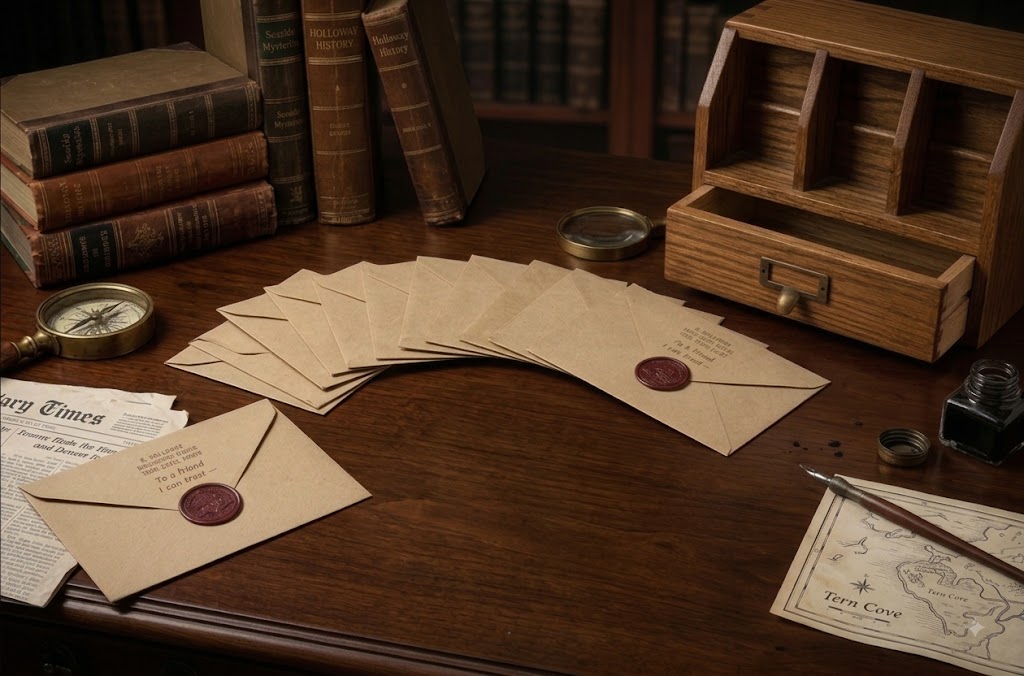
It is a story told in twelve letters, mailed over about four and a half months. Every envelope holds a letter and the physical documents that come with it: a telegram, a tide chart, a newspaper clipping, a medical certificate. It is 1923 on the coast of Maine, and a woman is trying to work out what happened to her sister.
Keeping twelve letters straight
Twelve letters came to 11,560 words, and something planted in the first one has to still be true in the eleventh. Every character has to not know things they have not learned yet. I could not hold that in my head, so I built something that could.
A continuity database, holding 271 established facts, each one tagged with which letter set it and who said it. Fact checking against canon, so any new sentence gets tested against everything already established. Implied-claim detection, which catches the claims a sentence makes without stating them, and that is where continuity actually breaks.
Character knowledge tracking: what each person knows, has not learned yet, and believes incorrectly, at every point in the story. Timeline validation. Verification reports, one per letter, listing conflicts, cautions, and everything that passed clean.
A custom AI integration, a server that hands the database to the AI so it checks its own work as it goes. And AI-tell removal, a line editor I built to pull the machine-made cadence out of prose, because I was not paying for one.
Turning a folder of files into a physical object
Print-ready PDF generation. Every letter and every insert compiled into one file, rebuilt from source on each run so the proof is never behind the writing. Two-up imposition, for true-size printing on standard sheets with a cut line.
Period document design, twenty-two of them, built as web pages and rendered to print. Per-character typography, a different hand for each person who writes something. A working cipher, with a printed decoder card that actually solves.
Selling it before it exists
A live site with email capture, deployed and taking addresses now. A crowdfunding campaign: tiers, goal, risks and FAQ, all written. Platform policy compliance, including the AI disclosure, checked line by line against the platform's own published rules.
Unit cost modeling, working out what one package costs at the smallest order I can place against what it costs at volume. Competitor research across a category that turned out to already exist.
Getting it in the mail
Postage rate-class analysis. The difference between a letter, a flat and a parcel is most of the margin on a thing like this. Packaging specification, worked out from the size of what goes inside it. Weight budgeting against the carrier's cap.
The story is written and it has been read. My mother has been through thousands of mysteries and still keeps turning up new ones, and she did not see the ending coming. That is the review I was after.
What is left is making the thing. A Kickstarter is being built to fund the first run, so for now the site takes an email rather than an order. After that it is paper, printing, wax and assembly, and getting the presentation right, which on a small independent run is most of the work.