Software that watches a stack of channels and tells me when three of them covered the same story.
I wanted to keep up with what was happening in AI on YouTube, and that is not actually possible. There is too much of it, and the same announcement gets covered by five channels inside a week. So I built something to watch them for me.
It takes every new video from the channels I track, transcribes it, reads the transcript and writes it up. Then it groups the week by what the videos are actually about, so three people covering one story arrive as a single named thing instead of three separate hours I do not have.
Getting the material in
Automatic channel monitoring, pulling in new videos as they get published. Account connection, so the channels I follow get picked straight out of my own subscription list.
Turning video into text
Automatic transcription of everything that comes in. Local transcription, running on my own machine, which puts the cost at nothing and takes about two and a half minutes of work for a twenty minute video with nobody sitting there.
Partway through building it, YouTube shut off the route I had been using to get captions. It now takes the audio and transcribes that, and it makes that call on its own when the first route comes back empty.
Reading it for me
Automatic summarization, in a short version and a long one. Content type classification into eight kinds: a business idea, a case study, a tutorial, a tool review, news analysis, a concept explainer, an interview, an opinion piece.
That classification then drives type-aware outlines, where the shape of the write-up changes to suit what the thing actually is. A case study comes back as background, challenge, approach, results and lessons. A tool review comes back as features, real use cases, pros and cons, verdict.
On top of that, structured extraction for the key takeaways and a set of specific things I could go and do afterwards, plus automatic tagging, automatic categorization, and a novelty score from one to ten.
Finding the overlap
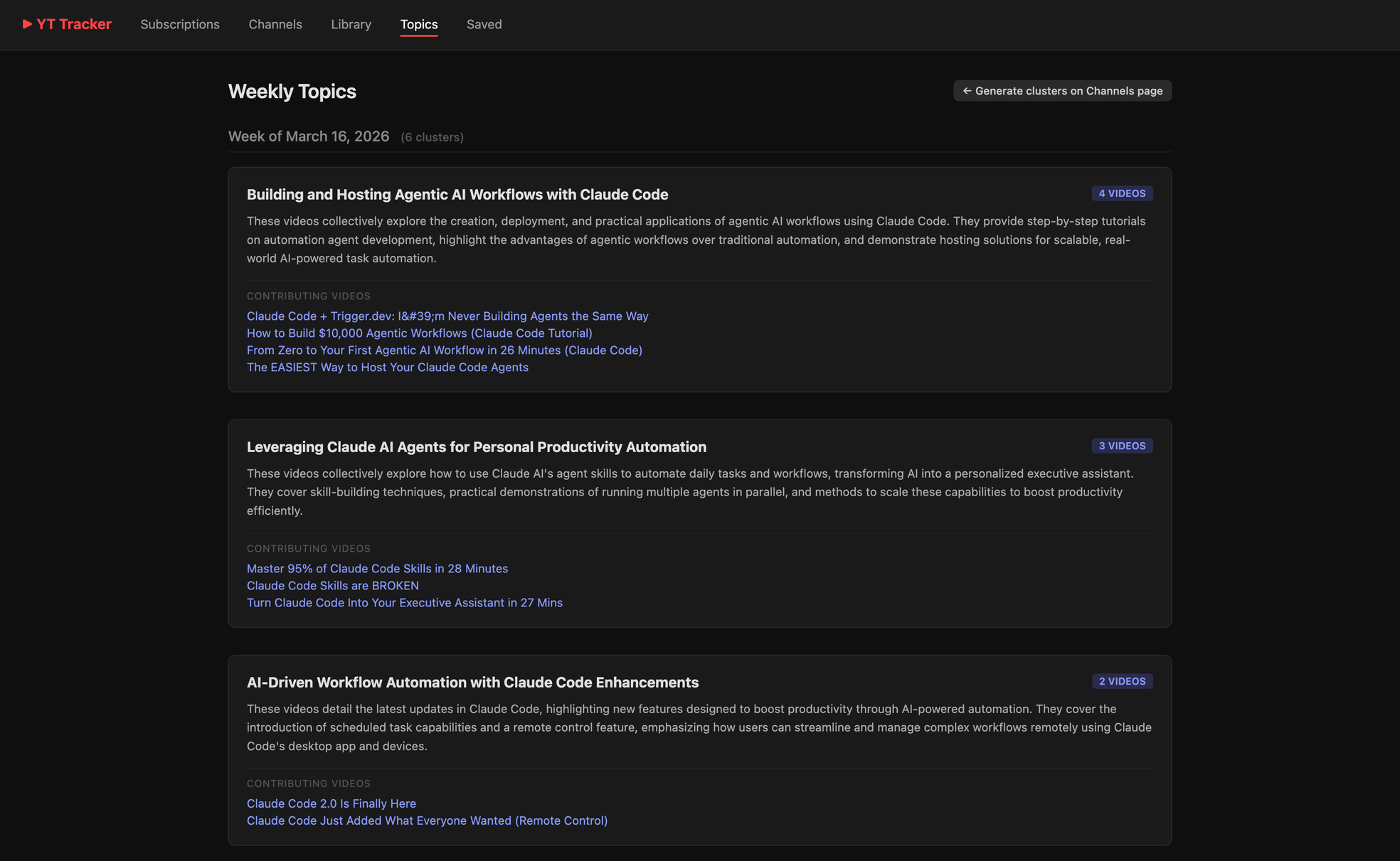
Semantic clustering, which groups the week's videos by meaning. Automatic topic naming, where each group gets handed back and comes home with a name and a description of what the whole group covers between them. Weekly topic digests built out of that.
A real one it produced: "Building and Hosting Agentic AI Workflows with Claude Code", four videos, with a paragraph explaining what they collectively say. That is the part I actually wanted. Grouping things that are similar is easy, and useless until something tells you what the group is.
Working with the result
A searchable library of everything it has processed. A job queue with live status, so I can see what is running and what fell over. An operations console, where any stage of the pipeline can be run, re-run or reset by hand.
It works, and I turned it off on purpose. It was doing the job I built it for, which turned out to be the problem. Every week it handed me a fresh pile of what was moving in AI, and then a pile of business ideas I could go and chase. I was already inside two builds that were each taking every spare hour I had, and the last thing either of them needed was a machine manufacturing new directions. So I stopped running it and stayed the course.
I never found out how far the output could go, either. Transcribed, grouped, named and written up, it is a genuinely useful pile of material and I only ever used the top of it.
The YouTube half is the part I happened to need. Point it at recorded calls, or meetings, or a decade of training video, and it does not care that none of them are YouTube.